
9. – 11. July
Berlin 2026
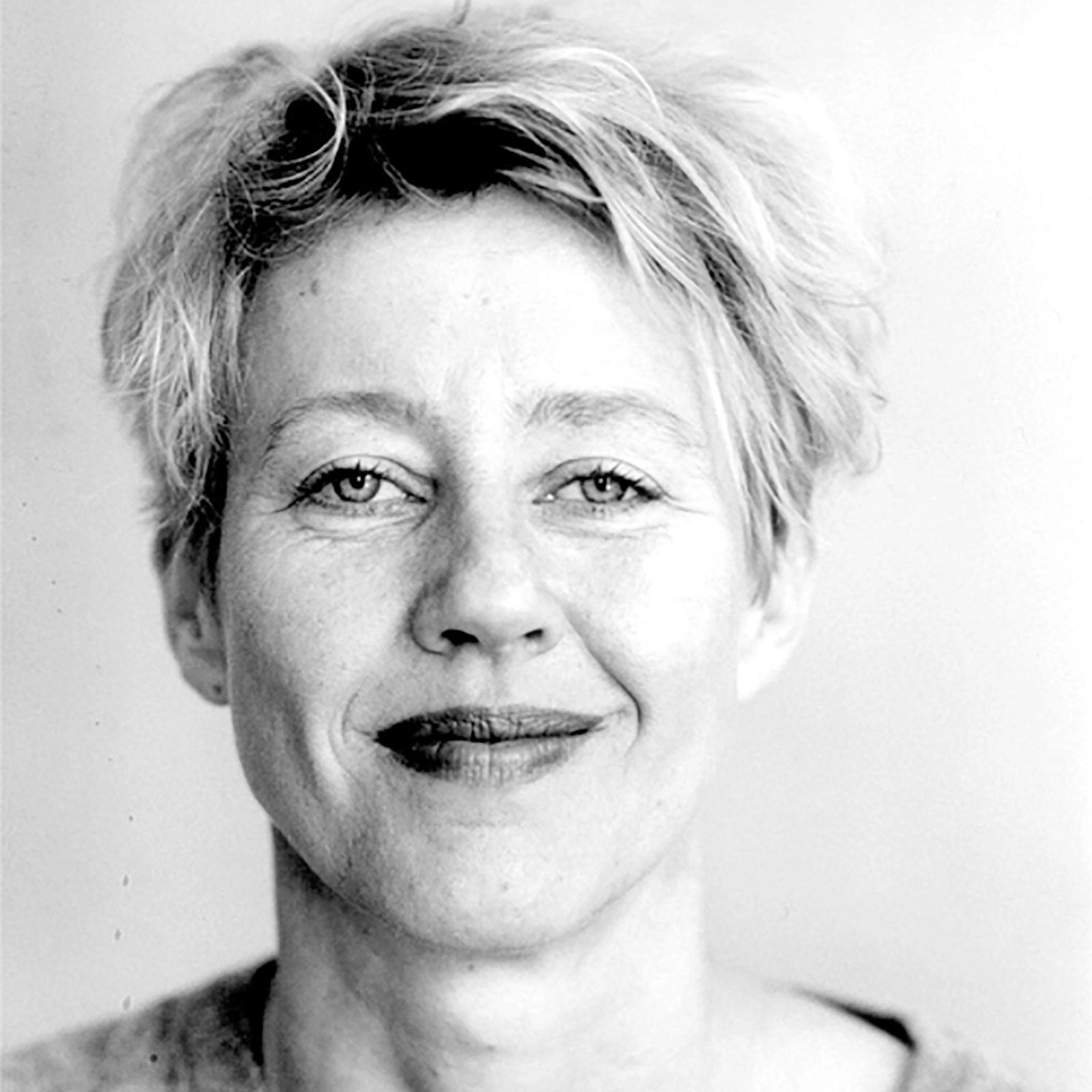
Photo © Susanne Müller
Iris ter Schiphorst
Portrait Concert with ensemble mosaik
Sometimes II (2016/2017)
Changeant (2004)
Transformationen III (2022/2026)
Anna’s Song (1993/2026)
meine-keine lieder/die aufgabe von musik (2014)
Breaking (2012)
Saturday, 11 July 2026
See day program >
»Sometimes II« is, in many ways, a tongue-in-cheek homage to the female protagonist ‘Bess’ from Lars von Trier’s film »Breaking the Waves«, which also served as the starting point for the composer’s previous work for ensemble mosaik, »Breaking«. »Sometimes II« is a short, at first glance, ‘simple’ piece that begins almost minimalistically. It is sometimes – ‘sometimes’ – interspersed with very short soloistic, quasi-free interludes, before ending in a strangely groovy section led by the piano and supported by the full ensemble. The amplified ensemble is framed by four thunder sheets equipped with transducers, which are repeatedly – ‘sometimes’ – set into resonance by the miked timpani or the timpanist. The title refers to a quote from the film’s protagonist, Bess: »Sometimes – we have a spiritual contact«.
»Changeant« – the title says it all: »Changeant« plays with roles, languages, styles, stereotypes and quotations, oscillating between serious and popular music, between performance, concert and music theater. It works with parody, gently questioning the »concept of the work« with a wink. »Changeant« was inspired by vocal performers such as Meredith Monk, Laurie Anderson, Shelley Hirsch, Diamanda Galás and Joan La Barbara and thus refers to a rather marginalized musical history in which the singer/performer – rather than the composer – is the center of focus. »Changeant« seeks to extend this lineage, albeit indirectly, through the medium of writing. »Changeant« is the ‘prescription’ of a performance and revolves around the notions of ‘presence’ and ‘representation’.
In »Transformationen«, multiple layers of time and media overlap: the musical playback is based on an archival recording from 1989, originally performed by the violinist Susanne Schulz and Iris ter Schiphorst on synthesizer/sampler, now edited and reassembled for the Transformationen series. The original piece was based, among other things, on field recordings of frogs made in Spain during the 1980s using a Sony Professional recorder. The recordings were later edited in a Casio sampler (with a memory capacity of just 1MB). Every evening, countless frogs gathered there for their daily concert. Today, neither the watering place nor the frogs remain, and the Casio FZ-1 sampler itself survives mainly as a reference in accounts of early sampler technology. The spoken playback is a recording of a voice from March 2022 reading the text of the poem »Diepe tijd« (Deep Time) by Dominique de Groen. The singers add another temporal and spatial dimension. In real-time performance, different strata of time and space begin to merge: long-past, ‘archaeological’ sounds from the playback, an acousmatic voice and the live sound of the string duo. In a certain sense, this approach resonates with the title and content of the poem »Diepe tijd« (Deep Time) by Flemish writer Dominique de Groen. The term ‘deep time’ was introduced by John McPhee in 1980–81 to describe a temporal dimension of millions or even billions of years, a scale capable of encompassing the slow evolutionary processes of the earth. Such a conception of time and evolution exceeds the limits of human comprehension.
»Anna’s Song« is based on »Anna’s Wake« (1992), a 3D opera for tape, live singer and 16mm film. »Anna’s Wake« playfully engages with both the history of opera and the medical case history of ‘Anna O…’, often described as the first ‘hysteric’ supposedly treated through psychoanalysis. This material is the basis for a multimedia work that moves in the wake of Joyce’s exuberant modernism, while also functioning as a wake for the stigma of a female illness. The story unfolds in three visually and musically distinct sections, tracing the mutability of a woman – Anna – whose shifting forms of appearance and expression resist fixation. Definitive interpretations do not hold her in place. If she has just ironized the gesture of an opera diva by singing bel canto, she may in the next moment be overcome by her own melancholic image. Moods and images shift continuously, oscillating like a swing. But across different eras, Anna is at least as much driven by her own acts of self-presentation as she appears to be subject to the shifting images and sounds and the media constructions surrounding her.
»meine-keine lieder« (my-no-songs/the task, the giving up of music), dedicated to Inge Müller, is conceived as a scholarly and artistic examination of the ‘intellectual climate’ during Müller’s lifetime (1925–1966) in Germany. It focuses in particular on the Nazi era and its reception in the 1960s, primarily through the lens of Hannah Arendt. At the same time, the composition serves as a tribute to Inge Müller, whose poems (»Meine Mutter wollt mich nicht haben« and »Ich steh mit einem Bein am Grab«) are fully integrated into the work.
»Breaking« (for amplified ensemble, sampler and live electronics) refers, among other things, to Lars von Trier’s film »Breaking the Waves«. The temporal progression of the piece corresponds proportionally to that of the film, as indicated by the ‘story-line’ in the score. Certain changes of location in the film are reflected in time signature changes within the composition and are assigned to specific instrumental combinations or sound files. At the same time, there is another sonic layer: the entire piece is framed by ‘dark’ sounds, enclosing musicians and audience alike within a vault of sound. This second sound level creates a kind of ‘cave situation’. Media philosophers describe the cave both as a place of retreat and as a site of (‘lying’) narrative, fantasy and memory. Caves are therefore places of regression and fascination and the question is always whether and how one might emerge from them again (or even wish to emerge at all). Orpheus tried, but ultimately failed, as does all music when it seeks to free itself from its own evolution – its own cave-ground – and to tell stories about, for example, the human being. This happens more often in cinema, perhaps the most popular cave-space of all. »Breaking the Waves« is exemplary in this respect: all its protagonists desire what is good, yet none truly knows what they are doing (also great cinema), namely, fulfilling the desires of others. In the film, this is called love. René Girard described this as ‘mimetic desire’ something that never works without sacrifice, or, as Elisabeth Bronfen once wrote, ‘over her dead body’. Bronfen could hardly have known Bess from »Breaking the Waves«, who in the end, loses her life in a cruel way, a victim who the good Lord seems to accept when, at the end, freed from her burial cave by Jan (oh, those bells!), He allows her ascent into heaven, while at the same time enabling Jan himself to rise again from his own hell, from the prison of his bodily cave. But that’s a story. Not music.
Iris ter Schiphorst is a composer, performer and author. Her approach to composition and her understanding of music have been strongly shaped by her extensive experience as a musician – first as a classical pianist, and later as a bass player, drummer, keyboardist and sound engineer in a wide range of rock and pop formations. Today, she is considered one of the defining voices of contemporary music. Her catalogue includes works across a wide range of genres, including thirteen orchestral works, several full-length music theater pieces and various film scores premiered by renowned ensembles in Germany and abroad. Emerging from her early engagement with electronic music, sampling and collective modes of production — including as co-founder of the electroacoustic ensemble »intrors« — she developed a distinctive musical language that seamlessly connects analog and digital sound worlds as well as aesthetic, performative and discursive dimensions. Her compositions often respond to socio-political themes. Numerous awards have recognized her continuously experimental practice, including the German Music Authors’ Prize, the prestigious Heidelberg Künstlerinnenpreis and a nomination for the Prix Italia. Since 2013, Iris ter Schiphorst has been a member of the Berlin Academy of Arts, where she was elected in 2023 to a second term as deputy director of the Music Section. From 2015 to 2022, she taught as a Professor of Media Composition at the mdw – University of Music and Performing Arts Vienna.
www.iris-ter-schiphorst.de/media