
9. – 11. July
Berlin 2026
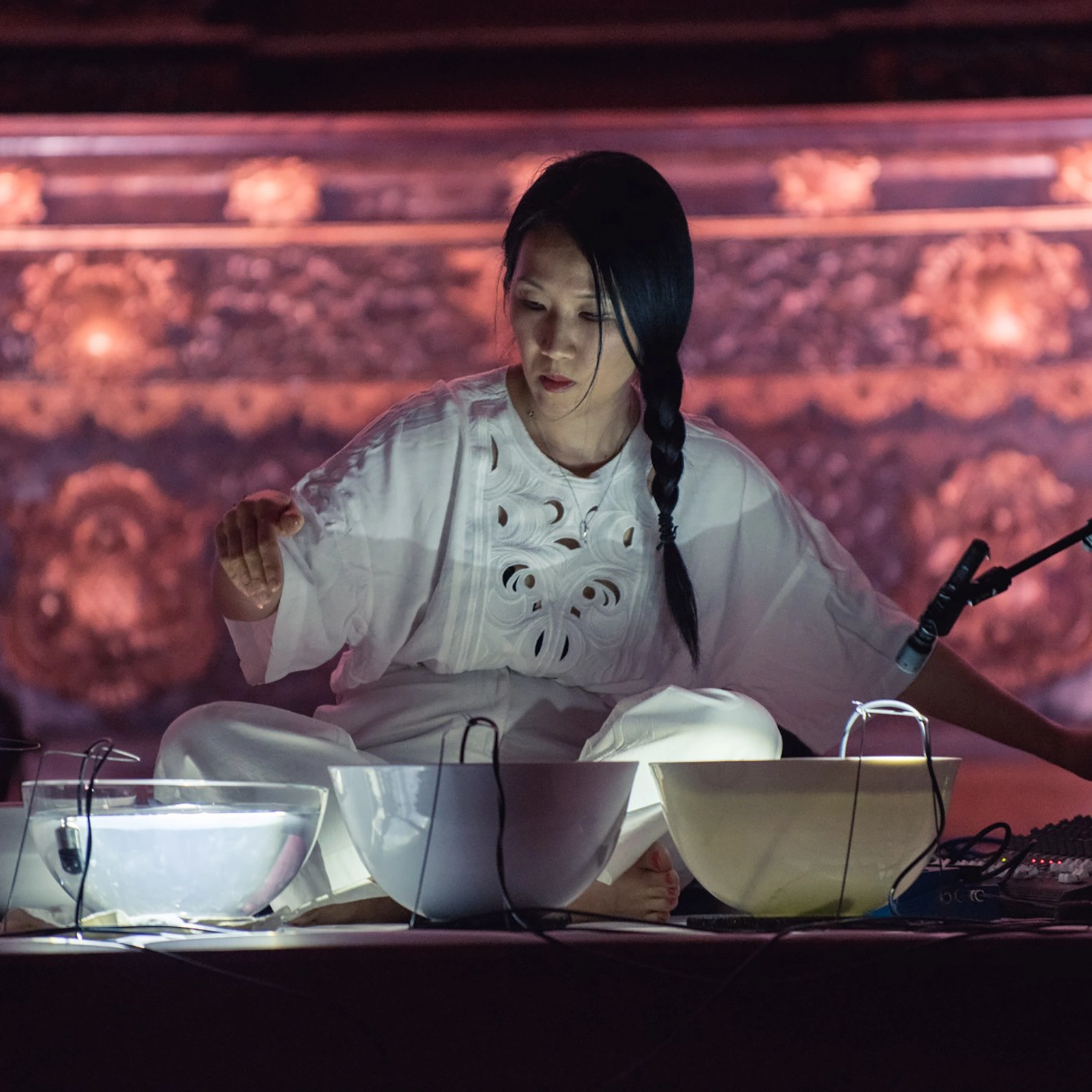
Photo © WOS Festival / Leo Lopez
Tomoko Sauvage
Waterbowls
for water, hydrophones, porcelain and glass bowls, stones, shells and electronics
Friday, 10 July 2026
See day program >
With »Waterbowls«, Tomoko Sauvage has developed an original musical instrument, initially inspired by the traditional South Indian instrument, ‘Jaltarang’. Through long-term experimentation and tactile research into the properties of materials, she transforms water-filled porcelain bowls into an aqueous electroacoustic instrument. She animates the inanimate by tuning water and vessels, setting them into vibration and amplifying subtle sounds that are otherwise almost inaudible. In her ‘amplified waters’, Tomoko Sauvage plays with water drops and waves, clay, stones, shells and glass objects as idiophonic or membranophonic instruments, often in combination with bubbles that function as underwater aerophones. Tomoko Sauvage’s deliberate use of acoustic feedback, a phenomenon generally perceived as disruptive, has led her to a comprehensive engagement with architecture, acoustic space and the presence of all participating materials. Her role as a performer can be understood as that of a gardener: she shapes what can be controlled and leaves the rest to chance.
Tomoko Sauvage is a Paris-based Japanese composer and artist best known for her long-standing musical and performance practice using a self-developed instrumentarium that combines water, ceramics and electronics. She brings inanimate materials to life by setting them into vibration and amplifying their tiny sounds – sounds that would otherwise remain almost inaudible. Her work focuses on the tactile materiality of resonant objects, metaphorical listening and the use of chance as a compositional method. For over two decades, she has performed internationally at institutions and festivals, including the Barbican Centre in London, the Palais de Tokyo in Paris, MaerzMusik in Berlin and the Nyege Nyege Festival in Uganda.
www.instagram.com/tomokosauvage